Salsa Compass

GALLERY I

History

More than a century traced along one timeline: from the mountains of eastern Cuba through the dance halls of Havana and Manhattan to the salsa scenes of Cali, Tokyo, and Zurich.

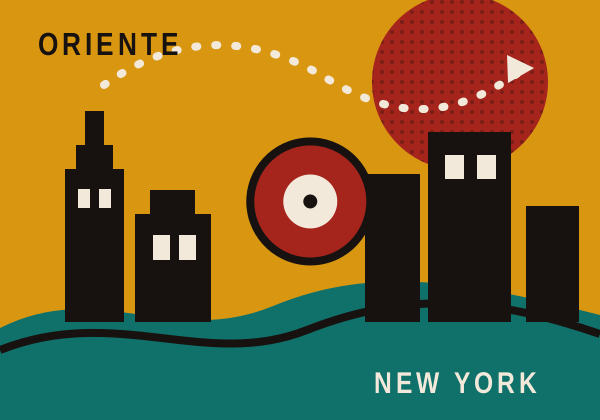
Poster-style map tracing salsa's musical journey from eastern Cuba to New York

Understanding the story

No date of invention

For many musical styles, one can point to a year, a place, or a recording. Salsa is different. What we call salsa today is a chain of transformations: a rural Cuban genre moves to the city, enters the dance-hall repertoire, crosses the sea, encounters jazz and Puerto Rican traditions in New York, and finally acquires a name rooted in marketing rather than music.

The timeline below shows this chain. It is deliberately arranged not as a family tree with a single root, but as a sequence of overlapping layers.

Timeline

From 1880 to the present

from 1880

Son emerges in eastern Cuba

In the mountains of Oriente Province, Spanish song forms and guitar traditions merge with African rhythms to create son cubano, salsa's most important ancestor.

Son also provides the structure of almost every later salsa track: a sung opening section (canto or largo), followed by the montuno, a call-and-response between lead singer and chorus over a repeating pattern.

1900s

Rumba, Bomba, Plena

Alongside it, Afro-Cuban rumba (Guaguancó, Yambú, Columbia) thrives in the port districts of Havana and Matanzas, supplying the rumba clave and much of the percussion vocabulary.

In Puerto Rico, bomba, a dialogue between drum and dance rooted on the coasts and in Loíza, and from the 1920s plena, a narrative “sung newspaper” from Ponce, shape the musical memory later drawn on by New York bands.

1937

Arcaño y sus Maravillas and Danzón-Mambo

Flutist Antonio Arcaño forms his charanga. Within it, brothers Orestes and Israel “Cachao” López develop the danzón de nuevo ritmo: a syncopated final section built on Son guajeos is added to the elegant Danzón. Orestes's 1938 composition “Mambo” gives it its name.

1939/40

Arsenio Rodríguez invents the Conjunto

Tres player Arsenio Rodríguez, blind since age seven and known as “El Ciego Maravilloso,” recasts the Son ensemble: he adds piano, second and third trumpets, and makes the conga (tumbadora) a permanent part of the line-up.

This line-up produces son montuno and “ritmo diablo,” driving instrumental sections that anticipate Mambo. Rodríguez maintained throughout his life that he was Mambo's true inventor. He moves to New York in 1952.

1946

The Palladium Ballroom opens

The Palladium Ballroom opens at Broadway and 53rd Street in Manhattan on March 15, 1946. From 1947 until its closure in 1966, it is the center of Latin dance music in New York, “the home of Mambo.”

Remarkably, the ballroom is not racially segregated. Dancing ability, rather than origin or class, is the social currency. The “Big Three” reign: Machito and his Afro-Cubans, Tito Puente, and Tito Rodríguez.

1949–1955

Mambo fever and Cha-Cha-Chá

Dámaso Pérez Prado popularizes Mambo worldwide with big-band arrangements (“Mambo No. 5”). Almost simultaneously, violinist and composer Enrique Jorrín develops cha-cha-chá with Orquesta América: a gentler, less syncopated version of Danzón-Mambo that non-professional couples can follow. Its onomatopoeic name comes from the shuffle of dance shoes.

from 1954

Cortijo y su Combo brings Bomba and Plena to radio

In Puerto Rico, percussionist Rafael Cortijo and singer Ismael Rivera bring the Black folk traditions Bomba and Plena into modern arranged pop, with hits including “El Bombón de Elena,” “El Negro Bembón” and “Quítate de la Vía Perico.”

This directly nourishes later salsa. Meanwhile, Mon Rivera develops the trombone-led “Trombanga” sound that will shape Willie Colón and Eddie Palmieri.

1959–1962

The break with Cuba

After the Cuban Revolution and the US embargo, direct exchange between Havana and New York is severed. “Afro-Cuban” becomes unusable as a marketing term in the US music industry.

The New York scene, now predominantly Puerto Rican, begins to develop independently. A new word fills precisely this gap a few years later.

1964

Fania Records

Dominican-born flutist and bandleader Johnny Pacheco founds Fania with lawyer Jerry Masucci. The name comes from a Cuban song or a Havana snack bar. Pacheco sells the first records from his car trunk; the first release is Cañonazo.

Fania will later often be called “the Motown of Latin music.”

1968–1975

The Fania All-Stars and the word “Salsa”

In 1968, the label's stars form its house band. Legendary events include the 1971 Club Cheetah concerts, Live at Yankee Stadium (1973) and a 1974 performance in Kinshasa, Zaire, around the Ali-Foreman fight.

During this period, “Salsa” takes hold as an umbrella term for Son, Guaracha, Guaguancó, Mambo, Cha-Cha-Chá, Pachanga, Boogaloo, Bomba and Plena. Who coined it is disputed: Johnny Pacheco is most often named, but Izzy Sanabria, concert host, Fania graphic designer and publisher of Latin NY, also claimed credit.

1970s

Salsa dura, the hard sound

The defining aesthetic of the Fania years: angular trombone sections, fast tempos, hard-driving percussion, and lyrics from the barrio. Willie Colón and Héctor Lavoe, Eddie Palmieri, Ray Barretto, El Gran Combo, La Sonora Ponceña.

In 1978 Willie Colón and Rubén Blades release Siembra, with “Pedro Navaja” and “Plástico.” Selling more than three million copies, it becomes the best-selling salsa album in history. Blades thereby establishes salsa consciente: salsa with socially critical lyrics.

1982

Salsa romántica

Producer Louie Ramírez releases Noche Caliente and turns it into a formula: Spanish-language pop ballads in salsa arrangements. The sound softens and the lyrics focus on love and eroticism.

This branch dominates commercially in the late 1980s and 1990s: Frankie Ruiz, Eddie Santiago, Lalo Rodríguez (“Ven Devórame Otra Vez”), Gilberto Santa Rosa, later Marc Anthony, La India and Víctor Manuelle. Salsa dura purists still resist it today.

1969–1990s

Cuba takes its own path: Songo and Timba

While salsa emerges in New York, Cuba continues innovating in parallel. Bassist Juan Formell forms Los Van Van in 1969 and develops songo with percussionist “Changuito.” Chucho Valdés's Irakere brings in jazz and rock.

In 1988 flutist José Luis Cortés (“El Tosco”) forms NG La Banda; their album En la calle (1989) defines timba: dense, aggressive and close to funk. Cortés himself coined the term. Timba shapes Cuban music during the early 1990s “Special Period.”

1970s–1990s

South America takes over

Salsa is no longer made only in the Caribbean and New York. In Venezuela Oscar D'León becomes the “Sonero del Mundo”; in Colombia Joe Arroyo and Grupo Niche shape a distinct sound.

Cali, Colombia, develops perhaps the world's densest salsa dance culture and claims the title “World Capital of Salsa.”

from 1997

Congresses: salsa goes global

Journalist Eli Irizarry organizes the world's first salsa congress in Puerto Rico. It attracts 375 participants from 19 countries; two years later there are 800 from 34 countries and around 56 dance companies.

From 1999, a sponsored “Congreso Mundial de la Salsa” tours New York, Los Angeles, Chicago, Miami, Tokyo, Valencia, Rome, Berlin, London, Amsterdam and Sydney. Today, well over a hundred congresses and festivals take place annually on every continent.

from 2010

New branches

Salsa choke emerges in Colombia, an urban mix of salsa and Reggaetón often danced solo or in group choreography and closely associated with Cali.

At the same time, the salsa dance scene has become a global network of schools, festivals and competitions, raising questions of authenticity, origin and who owns a culture danced everywhere. More in Gallery V.

Gallery afterword

What the timeline leaves out

A timeline suggests an orderly sequence. In reality, much happened simultaneously, in opposition and in both directions: Cuban musicians played in New York, New York records were heard in Cali, and Colombian bands shaped the Venezuelan market.

The historical record is also skewed. Salsa history is well documented where record companies kept archives, above all in New York. What happened in Cuban dance halls, Puerto Rican living rooms and Colombian neighborhoods is documented far less well, although it was no less important musically.

Continue reading

Gallery II introduces the people behind these dates. Gallery IV explains what happens rhythmically in this music. The sources page sets out the basis for this account and what remains disputed.